


Types Of Bath

Introduction
The type of bath you choose will often dictate the choice of materials it is made from. Fitted baths are invariably made from enamelled pressed steel, acrylic or glass-reinforced plastic (GRP), however those designed to be free standing can be made from almost any suitable material.
- Although strong, modern plastic baths can be harmed by some abrasive cleaners, even bleach is not recommended.
Fitted baths
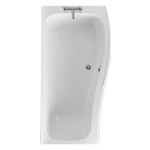
The most popular form of bath, fitted baths are often boxed into a corner and sealed in place using a waterproof sealant. The open side(s) are covered with a matching panel which is usually supplied with the bath.
Fitted baths have the advantage of being easy to fit, all the plumbing is hidden behind panelling, and they are ideal for the addition of a shower if space is limited.
Most commonly available as a basic rectangle with tap fittings on one of the short sides, fitted baths are also available in a large variety of shapes and sizes, from square half-sized, through corner baths, to shower friendly baths which are wider at the head end to provide elbow room for showering.
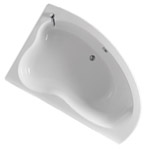
If considering a corner bath remember that the actual floor space required is greater than a rectangular bath of the same capacity, however as the tub is turned at an angle to the room they often take up less wall space.
If money is no object then fitted baths are available in pretty much any material that is suitable, however on the whole 99% of products available are made from enamelled pressed steel or glass-reinforced plastic (GRP).
At the price sensitive end of the market fitted baths are often made from acrylic, which is more than sufficient for most peoples needs, however they must be fitted, secured and supported correctly otherwise they have a habit of flexing which could lead to breakages occurring.
- Dimensions: Corner baths on average are 1565mm wide against the wall, and project strong>1075mm into the room. The bath should be a maximum of 550mm high at the rim.
- Dimensions: Rectangular baths on average are 1700mm wide against the wall, and project strong>800mm into the room. The bath should be a maximum of 560mm high at the rim.
Free standing baths
From an antique cast iron to modern ceramic roll-top, free standing baths provide a sense of occasion to each bath time as well as providing a feature to any bathroom.
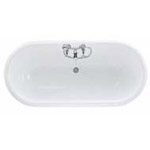
On the downside free standing baths are often impractical in all but large bathrooms where there is enough room around them to safely climb in and out. Also, as there is no panelling, it is harder to hide the plumbing, although that said modern examples often make a feature of the plumbing too with, for example, chromed pipes rising out of the floor.
Unlike fitted baths, free standing baths are more frequently available in non-traditional materials such as glass, stone, cast iron, ceramics and even Corian(r), as well as the familiar enamelled pressed steel and glass-reinforced plastic (GRP). Note that plastic baths will need to be supported using a purpose made cradle to provide increased rigidity.
- Dimensions: Free standing baths vary between 1500mm and 1700mm on the longest edge, and are 700mm wide. The bath should be a maximum of 560mm high at the rim.
Recessed baths
Often thought of as sunken baths, recessed baths are similar in format to fitted baths however they are fitted in place on all four sides.

When considering a recessed bath the options are truly endless. If budget and space is no option then the bath can be any size and shape and can be made from any suitable material.
The cheapest option when considering a recessed bath is to simply use a fitted style bath and build a tiled unit up to the level of the rim to give the impression of being recessed.
- Dimensions: Sunken baths can be any size you like!
Further information and useful links
- Find a Bathroom Showroom near to you
- Find a Bathroom Fitter near you
- Find a Bathroom Fixtures & Fittings supplier near you
- Find a Plumber near you
Site Pages
Featured Articles