


Choosing A New Hot Water Storage System

Introduction
Most homes in the UK require the storage of hot water, unless they use a combination boiler to heat the water. The standard way to store hot water is by using a copper cylinder, which is often located in an airing cupboard.
There are two distinct options for how a hot water cylinder recieves cold water. In both cases cold water is fed into the base of the cylinder, as it is heated it rises to the top, where it is drawn off and piped to the hot taps and shower(s). As the hot water is drawn out of the vessel, it is replaced by cold water at the base.
Hot water storage options
There are a number of options when it comes to how exactly the hot water is stored and distributed around your home, and as with most things the choice of which one is best suited to your needs will come down to the space available and your budget.
Below is a summary of the pros and cons of each type, with links to the full detail pages:
Vented hot water cylinders

- Can be fitted by a regular plumber or keen DIYer
- Cheaper than alternative storage systems
- Easier to maintain
- Requires a cold water storage tank
- Gravity fed showers may require a pump if performance is unsatisfactory
Combination vented hot water cylinders
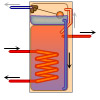
- Can be fitted by a regular plumber or keen DIYer
- Ideal for a small flat or loft conversion in small house
- Takes up much less space than a standard vented system
- Easier to maintain
- Available in a limited number of sizes
- Not suitable for a large family
- Hot water pressure can be very low from this system
- Gravity fed showers may require a pump if performance is unsatisfactory
Thermal store hot water cylinders
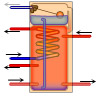
- Provides hot water at mains water pressure throughout the property
- Requires much smaller cold water tank then std vented systems
- Combined units occupy a lot less space in a property
- Cannot be used with power showers and some mixer shower valves
- Requires specialist installation
- Often more expensive that a vented system
- Requires a gravity feed to supply radiators
Unvented hot water cylinders
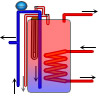
- Provides hot water at mains water pressure throughout the property
- Does not require cold water tanks and ventillation pipes
- Works with existing pipework
- Does not rely on gravity at all so can be located anywhere within a property
- Cannot be used with power showers and some mixer shower valves
- Requires specialist installation
- Often more expensive than a vented system
Heating the water
There are two different methods for heating water within a hot water cylinder; either directly using an electric immersion heater, or indirectly using a heat exchanger supplied via a hot water boiler.
An Immersion element is a very convenient option as it will heat the water very quickly, however compared to the cost of using the boiler to provide the heat, this is a very expensive option. The option of 'Economy 7' can reduce this cost a little, by running the immersion late at night when electricity is cheaper, however this is not as popular these days as it used to be.
By far the most economical option is to use a heat exchanger to heat the water in the vessel. Hot water from the boiler flows through a series of coils within the hot water cylinder, which in turn heats the water. The heat exchanger is part of a completely seperate system, which has its own feed and expansion tank, also located in the loft space.
Most hot water cylinders are available with the fittings for both an immersion heater and a heat exchanger, and it is well worth, connecting both up if you are able. This means that the boiler provides hot water 99% of the time, but the immersion is there to provide hot water if the boiler fails.
- If you have the space, you can also provide electricity for the immersion using photovoltaic cells, or you can provide hot water for the heat exchanger using a solar water heater.
Capacity of the storage cylinder
Both vented and unvented hot water cylinders are available in a wide range of sizes, from 74 litres (16 gallons) to 450 litres (99 gallons).
A cylinder of 200 litres (44 gallons) will store enough hot water to supply an average family with hot water for a day. If you prefer power showers and/or have a large family, it is advisable to consider a larger cylinder to ensure your needs are met.
Traditionally hot water tanks/cylinders are made from uninsulated copper, and as such they required insulation inorder to prevent high levels of heat loss. Modern cylinders are available pre-insulated with a thick layer of polyurethane, and although more expensive are well worth the extra outlay.
- Make sure your new lagged hot water cylinder carries a kitemark, as this will ensure the insulating properties will comply with Part L of the Building Regulations, regarding conservation of energy.
How to change a hot water cylinder
Replacing a standard vented hot water cylinder is well within the bounds of a keen DIYer. Just make sure you have turned the mains water supply off, or have isolated the cold water storage tank, and have fully drained the cylinder before you loosen the pipwork connected to it.
Further information and useful links
- Find a Heating Engineer near you
- Find a Gas Engineer near you
- Find a Plumbing Merchants near you
Site Pages
Featured Articles