


Putting up wall shelves

Introduction
Putting up shelving is a relatively straightforward task, however if a few basic rules are not followed it can all go horribly wrong.
Remember to use shelving brackets which are long enough to support the entire shelf depth, this is especially important when using deep shelving and heavy loads as the cantilever action of the load on the shelf will damage either the shelf, the wall or both.
If you are planning to mount a shelf/bracket to carry a large TV set (or a similar heavy load), it is advisable to use wall bolts in a masonary wall rather than plugs and screws.
Tools for the job
To put up a shelf, you will need:
- Electric Drill
- Spirit level
- Screwdriver
- Tape measure
- 2in wallplugs

Wall types
Often the biggest driver of the type and positioning of your shelves will be the type of wall you are planning to mount them on. If the total load on the shelf is very heavy (>20Kg), then the shelves must be fixed to a solid masonary wall.
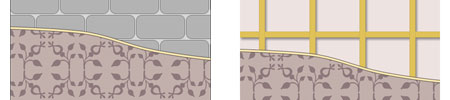
- Masonary walls
Will accomodate almost any type of shelf fitting, in practically any spot on the wall. Take care when drilling into the wall, and always use a wallplug. Remember to drill a hole to accomodate the wallplug, not the screw. - Plasterboard stud walls
Ideally the shelf bracket should be fixed to the timber studs, use a stud finder to locate and mark where the studs are. For light loads (<5Kg), the shelving can be attached to just the platerboard using purpose built cavity fixings. To avoid damage to the wall, use 3 shelf brackets (rather than just 2) to spread the load.
Using individual shelf brackets
Procedure for fitting a wooden shelf onto 2 brackets.
- Hold the shelf against the wall in location you wish for it, and mark the wall with a pencil dot to indicate the ends of the shelf.
- Divide the length of the shelf by 4 and take this value from each of the marks on the wall. You should now have 4 marks, 2 showing the length of the shelf and 1 for each bracket 25% in from each end.
- Place a bracket against the wall over the left hand bracket mark, and balance the spirit level on top of the bracket. Gently adjust the postion of the bracket until it is level.
- Using the pencil mark each of the screw holes onto the wall through the bracket.
- Drill the wall for this first bracket, making holes large enough for the wallplugs.
- Gently tap a wallplug into each hole using a hammer, then screw the bracket into place using 2in screws.
-
- Hold the shelf in place over this first bracket, and place the spirit level on top of the shelf. Gently adjust the shelf up and down until the shelf is level.
- With the shelf still in place, place the second bracket against the wall under the shelf in the correct position (25% in). Mark each of the screw holes onto the wall through the bracket using a pencil.
- Put the shelf to one side and drill the wall for the second bracket, making holes large enough for the wallplugs.
- Gently tap a wallplug into each hole using a hammer, then screw the bracket into place.
-
- Finally, fix the shelf onto the brackets using 1/2in screws.
- If you are planning on fitting a number of shelves onto a single wall, then use a plumb-line to line up the brackets to ensure a neat finish.
Fitting alcove shelving
Alcove shelving is attached to wooden batterns (or pre-made extruded metal supports) which afix to each side wall, with the shelf sitting on each. They are the same depth as the shelf, to fully support the load, and are fitted in a similar way to individual shelf brackets (see above).
If using wooden batterns, consider the following:
- For simple shelves, cut the front edge of the battern to a 45 degree angle (sloping downwards and back).
- For a more substantial look, apply a deep edging to the front of the shelf to completely cover the side batterns.
- Apply a thin sheet of plywood to the underside of the batterns and front edging. Paint the shelves to match the alcove walls.
Installing a shelving system
- Assuming you have marked the wall with a pencil mark to indicate the positions of the shelves, place the first of the upright supports into position and mark the position of the top screw hole onto the wall.
- Drill and plug this hole, then loosely screw the support into place with this single screw.
- Using the spirit level, gently adjust the position of the bottom of the support until it is vertical. Mark the position of the bottom screw hole onto the wall.
- Drill and plug the bottom hole, and screw the support into place. Mark any further screw holes onto the wall.
- Clip a bracket into the support mounted onto the wall, and clip a second bracket into a new support (into the same numbered slot as on the first support).
- Place a shelf across the two supports and, using a spirit level on the shelf, gently adjust the position of the second support until the shelf is level.
- Mark the screw hole at the top of the second bracket, and repeat the levelling procedure as described for the inital support.
- When the two supports are aligned correctly, remove both from the wall and drill and plug the remaining screw holes. Ensure that you use as many screws as necessary to take the loads you plan to place on the shelving.
- Add any further supports in the same way as for the second support.
- Attach the brackets to the shelves, and clip into your desired position.
Further information and useful links
- Introduction to wall mounted shelving
- More walls and ceilings topics
- Find the right tools & materials for the job
- Find a Power Tools supplier near you
- Find a Decorators Merchants near you
- Find a Paint Materials store near you
Site Pages
Featured Articles